Le Chateliers Principle Review Activity Worksheet Answer Key Text Reference Section 18-8
Chapter thirteen. Fundamental Equilibrium Concepts
xiii.3 Shifting Equilibria: Le Châtelier'southward Principle
Learning Objectives
By the end of this section, you lot will be able to:
- Draw the ways in which an equilibrium system tin can be stressed
- Predict the response of a stressed equilibrium using Le Châtelier's principle
Every bit we saw in the previous section, reactions continue in both directions (reactants get to products and products get to reactants). We can tell a reaction is at equilibrium if the reaction caliber (Q) is equal to the equilibrium abiding (Yard). Nosotros next address what happens when a system at equilibrium is disturbed and then that Q is no longer equal to K. If a organisation at equilibrium is subjected to a perturbance or stress (such as a change in concentration) the position of equilibrium changes. Since this stress affects the concentrations of the reactants and the products, the value of Q will no longer equal the value of K. To re-constitute equilibrium, the organization volition either shift toward the products (if Q < K) or the reactants (if Q > One thousand) until Q returns to the aforementioned value as M.
This procedure is described by Le Châtelier'south principle: When a chemic system at equilibrium is disturbed, information technology returns to equilibrium by counteracting the disturbance. As described in the previous paragraph, the disturbance causes a change in Q; the reaction will shift to re-establish Q = K.
Predicting the Management of a Reversible Reaction
Le Châtelier'south principle tin be used to predict changes in equilibrium concentrations when a system that is at equilibrium is subjected to a stress. Notwithstanding, if we have a mixture of reactants and products that take non however reached equilibrium, the changes necessary to achieve equilibrium may not exist so obvious. In such a case, nosotros can compare the values of Q and K for the system to predict the changes.
Issue of Alter in Concentration on Equilibrium
A chemical system at equilibrium can exist temporarily shifted out of equilibrium by calculation or removing one or more of the reactants or products. The concentrations of both reactants and products then undergo additional changes to render the system to equilibrium.
The stress on the arrangement in Figure one is the reduction of the equilibrium concentration of SCN− (lowering the concentration of i of the reactants would cause Q to be larger than K). As a consequence, Le Châtelier's principle leads us to predict that the concentration of Fe(SCN)2+ should decrease, increasing the concentration of SCN− part way back to its original concentration, and increasing the concentration of Fe3+ above its initial equilibrium concentration.
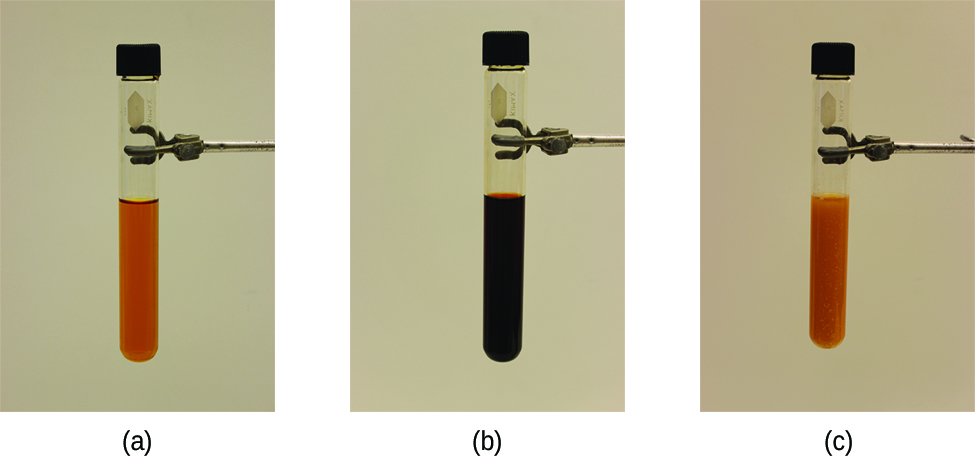
The effect of a change in concentration on a system at equilibrium is illustrated further by the equilibrium of this chemical reaction:
[latex]\text{H}_2(1000)\;+\;\text{I}_2(yard)\;{\rightleftharpoons}\;two\text{HI}(thousand)\;\;\;\;\;\;\;K_c = fifty.0\;\text{at}\;400\;^{\circ}\text{C}[/latex]
The numeric values for this example have been determined experimentally. A mixture of gases at 400 °C with [Htwo] = [Itwo] = 0.221 M and [Hullo] = 1.563 One thousand is at equilibrium; for this mixture, Qc = Kc = 50.0. If Htwo is introduced into the system so quickly that its concentration doubles before it begins to react (new [H2] = 0.442 M), the reaction will shift then that a new equilibrium is reached, at which [Htwo] = 0.374 M, [Itwo] = 0.153 Yard, and [HI] = 1.692 G. This gives:
[latex]Q_c = \frac{[\text{Howdy}]^2}{[\text{H}_2][\text{I}_2]} = \frac{(1.692)^two}{(0.374)(0.153)} = l.0 = K_c[/latex]
We have stressed this arrangement past introducing additional H2. The stress is relieved when the reaction shifts to the right, using up some (but not all) of the excess Hii, reducing the corporeality of uncombined I2, and forming additional Hi.
Effect of Modify in Pressure on Equilibrium
Sometimes nosotros tin change the position of equilibrium past irresolute the pressure of a system. However, changes in pressure have a measurable outcome just in systems in which gases are involved, so simply when the chemical reaction produces a modify in the full number of gas molecules in the system. An easy style to recognize such a system is to look for unlike numbers of moles of gas on the reactant and product sides of the equilibrium. While evaluating pressure (also as related factors similar volume), it is important to remember that equilibrium constants are defined with regard to concentration (for Kc ) or partial pressure (for KP ). Some changes to total pressure, similar adding an inert gas that is not part of the equilibrium, will alter the total pressure level but not the fractional pressures of the gases in the equilibrium constant expression. Thus, improver of a gas not involved in the equilibrium will not perturb the equilibrium.

Check out this link to see a dramatic visual demonstration of how equilibrium changes with pressure changes.
Equally we increase the pressure of a gaseous arrangement at equilibrium, either by decreasing the volume of the system or by adding more of one of the components of the equilibrium mixture, we introduce a stress by increasing the partial pressures of one or more of the components. In accordance with Le Châtelier'southward principle, a shift in the equilibrium that reduces the total number of molecules per unit of volume will be favored because this relieves the stress. The opposite reaction would be favored by a decrease in pressure level.
Consider what happens when nosotros increase the force per unit area on a arrangement in which NO, O2, and NOtwo are at equilibrium:
[latex]ii\text{NO}(chiliad)\;+\;\text{O}_2(m)\;{\rightleftharpoons}\;2\text{NO}_2(g)[/latex]
The formation of additional amounts of NOtwo decreases the total number of molecules in the organization because each time two molecules of NOtwo class, a full of iii molecules of NO and O2 are consumed. This reduces the total pressure exerted by the system and reduces, simply does not completely relieve, the stress of the increased force per unit area. On the other manus, a decrease in the pressure level on the system favors decomposition of NOtwo into NO and Oii, which tends to restore the pressure level.
Now consider this reaction:
[latex]\text{N}_2(g)\;+\;\text{O}_2(g)\;{\rightleftharpoons}\;2\text{NO}(g)[/latex]
Considering there is no alter in the total number of molecules in the system during reaction, a modify in pressure does not favor either germination or decomposition of gaseous nitrogen monoxide.
Effect of Change in Temperature on Equilibrium
Changing concentration or pressure level perturbs an equilibrium because the reaction quotient is shifted away from the equilibrium value. Changing the temperature of a organization at equilibrium has a different effect: A change in temperature actually changes the value of the equilibrium constant. However, we can qualitatively predict the effect of the temperature change by treating information technology every bit a stress on the system and applying Le Châtelier's principle.
When hydrogen reacts with gaseous iodine, estrus is evolved.
[latex]\text{H}_2(thou)\;+\;\text{I}_2(m)\;{\rightleftharpoons}\;2\text{How-do-you-do}(one thousand)\;\;\;\;\;\;\;{\Delta}H = -9.4\;\text{kJ\;(exothermic)}[/latex]
Because this reaction is exothermic, we can write it with estrus as a product.
[latex]\text{H}_2(g)\;+\;\text{I}_2(g)\;{\rightleftharpoons}\;two\text{Hullo}(thousand)\;+\;\text{heat}[/latex]
Increasing the temperature of the reaction increases the internal energy of the system. Thus, increasing the temperature has the effect of increasing the amount of ane of the products of this reaction. The reaction shifts to the left to relieve the stress, and in that location is an increase in the concentration of Hii and Iii and a reduction in the concentration of HI. Lowering the temperature of this system reduces the amount of free energy present, favors the production of heat, and favors the formation of hydrogen iodide.
When nosotros change the temperature of a system at equilibrium, the equilibrium constant for the reaction changes. Lowering the temperature in the Hello organisation increases the equilibrium constant: At the new equilibrium the concentration of HI has increased and the concentrations of H2 and I2 decreased. Raising the temperature decreases the value of the equilibrium abiding, from 67.5 at 357 °C to 50.0 at 400 °C.
Temperature affects the equilibrium between NO2 and Northward2Oiv in this reaction
[latex]\text{Northward}_2\text{O}_4(g)\;{\rightleftharpoons}\;2\text{NO}_2(g)\;\;\;\;\;\;\;{\Delta}H = 57.20\;\text{kJ}[/latex]
The positive ΔH value tells us that the reaction is endothermic and could exist written
[latex]\text{heat}\;+\;\text{N}_2\text{O}_4(g)\;{\rightleftharpoons}\;2\text{NO}_2(g)[/latex]
At higher temperatures, the gas mixture has a deep dark-brown colour, indicative of a pregnant corporeality of brown NO2 molecules. If, however, we put a stress on the organization by cooling the mixture (withdrawing energy), the equilibrium shifts to the left to supply some of the free energy lost by cooling. The concentration of colorless NiiO4 increases, and the concentration of brown NO2 decreases, causing the brown color to fade.
This interactive animation allows you to apply Le Châtelier's principle to predict the effects of changes in concentration, force per unit area, and temperature on reactant and production concentrations.
Catalysts Do Not Affect Equilibrium
As we learned during our study of kinetics, a catalyst tin speed up the charge per unit of a reaction. Though this increase in reaction rate may cause a system to reach equilibrium more than quickly (past speeding upward the forward and opposite reactions), a catalyst has no issue on the value of an equilibrium abiding nor on equilibrium concentrations.
The coaction of changes in concentration or pressure, temperature, and the lack of an influence of a catalyst on a chemical equilibrium is illustrated in the industrial synthesis of ammonia from nitrogen and hydrogen co-ordinate to the equation
[latex]\text{North}_2(thousand)\;+\;3\text{H}_2(1000)\;{\rightleftharpoons}\;2\text{NH}_3(thousand)[/latex]
A large quantity of ammonia is manufactured by this reaction. Each year, ammonia is amongst the top x chemicals, by mass, manufactured in the earth. Virtually two billion pounds are manufactured in the United States each twelvemonth.
Ammonia plays a vital office in our global economy. It is used in the production of fertilizers and is, itself, an important fertilizer for the growth of corn, cotton wool, and other crops. Large quantities of ammonia are converted to nitric acid, which plays an important role in the product of fertilizers, explosives, plastics, dyes, and fibers, and is besides used in the steel industry.
Fritz Haber
In the early 20th century, German chemist Fritz Haber (Effigy 2) adult a applied process for converting diatomic nitrogen, which cannot be used past plants as a food, to ammonia, a form of nitrogen that is easiest for plants to absorb.
[latex]\text{N}_2(one thousand)\;+\;3\text{H}_2(yard)\;{\leftrightharpoons}\;two\text{NH}_3(g)[/latex]
The availability of nitrogen is a strong limiting factor to the growth of plants. Despite accounting for 78% of air, diatomic nitrogen (N2) is nutritionally unavailable due the tremendous stability of the nitrogen-nitrogen triple bond. For plants to employ atmospheric nitrogen, the nitrogen must be converted to a more bioavailable form (this conversion is called nitrogen fixation).
Haber was born in Breslau, Prussia (presently Wroclaw, Poland) in December 1868. He went on to study chemistry and, while at the University of Karlsruhe, he adult what would later be known as the Haber process: the catalytic formation of ammonia from hydrogen and atmospheric nitrogen under high temperatures and pressures. For this piece of work, Haber was awarded the 1918 Nobel Prize in Chemistry for synthesis of ammonia from its elements. The Haber process was a benefaction to agriculture, as it allowed the production of fertilizers to no longer be dependent on mined feed stocks such equally sodium nitrate. Currently, the annual production of synthetic nitrogen fertilizers exceeds 100 million tons and synthetic fertilizer product has increased the number of humans that arable state can support from 1.9 persons per hectare in 1908 to four.3 in 2008.
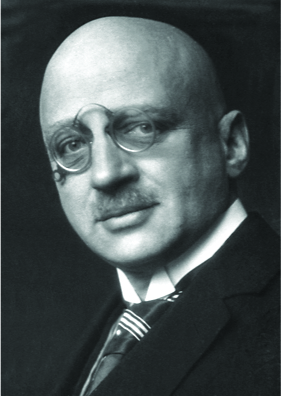
In addition to his work in ammonia production, Haber is likewise remembered by history as one of the fathers of chemical warfare. During Globe War I, he played a major role in the development of poisonous gases used for trench warfare. Regarding his function in these developments, Haber said, "During peace time a scientist belongs to the Globe, but during war time he belongs to his country."[ane] Haber defended the use of gas warfare against accusations that it was inhumane, saying that death was death, by any means it was inflicted. He stands as an example of the ethical dilemmas that face scientists in times of state of war and the double-edged nature of the sword of science.
Like Haber, the products made from ammonia can exist multifaceted. In add-on to their value for agriculture, nitrogen compounds can also be used to accomplish destructive ends. Ammonium nitrate has also been used in explosives, including improvised explosive devices. Ammonium nitrate was 1 of the components of the flop used in the attack on the Alfred P. Murrah Federal Building in downtown Oklahoma City on April xix, 1995.
It has long been known that nitrogen and hydrogen react to grade ammonia. However, it became possible to manufacture ammonia in useful quantities by the reaction of nitrogen and hydrogen only in the early 20th century after the factors that influence its equilibrium were understood.
To be practical, an industrial process must give a big yield of product relatively apace. One way to increase the yield of ammonia is to increment the pressure level on the system in which North2, H2, and NH3 are at equilibrium or are coming to equilibrium.
[latex]\text{Northward}_2(chiliad)\;+\;3\text{H}_2(g)\;{\rightleftharpoons}\;2\text{NH}_3(g)[/latex]
The germination of additional amounts of ammonia reduces the total pressure exerted by the system and somewhat reduces the stress of the increased pressure level.
Although increasing the pressure of a mixture of N2, Hii, and NHthree volition increment the yield of ammonia, at depression temperatures, the rate of formation of ammonia is boring. At room temperature, for example, the reaction is so slow that if we prepared a mixture of Nii and H2, no detectable amount of ammonia would class during our lifetime. The formation of ammonia from hydrogen and nitrogen is an exothermic process:
[latex]\text{North}_2(g)\;+\;three\text{H}_2(g)\;{\longrightarrow}\;2\text{NH}_3(g)\;\;\;\;\;\;\;{\Delta}H = -92.two\;\text{kJ}[/latex]
Thus, increasing the temperature to increment the rate lowers the yield. If we lower the temperature to shift the equilibrium to favor the formation of more than ammonia, equilibrium is reached more slowly considering of the big subtract of reaction rate with decreasing temperature.
Part of the charge per unit of germination lost past operating at lower temperatures can be recovered by using a goad. The cyberspace result of the catalyst on the reaction is to cause equilibrium to be reached more than rapidly.
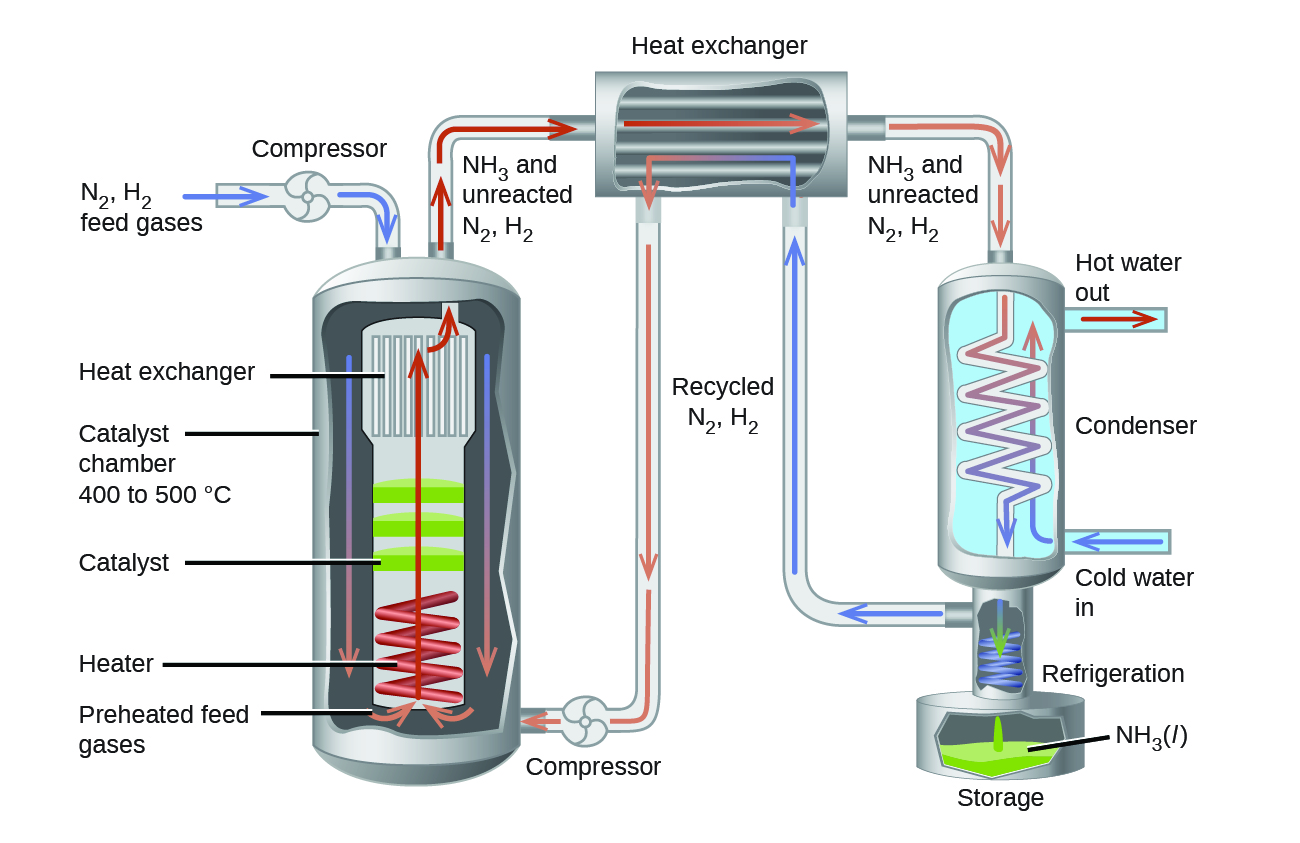
In the commercial production of ammonia, conditions of about 500 °C, 150–900 atm, and the presence of a catalyst are used to give the all-time compromise amongst rate, yield, and the toll of the equipment necessary to produce and comprise high-pressure level gases at high temperatures (Figure iii).
Key Concepts and Summary
Systems at equilibrium can be disturbed by changes to temperature, concentration, and, in some cases, volume and pressure; volume and pressure changes will disturb equilibrium if the number of moles of gas is different on the reactant and product sides of the reaction. The system's response to these disturbances is described past Le Châtelier's principle: The organisation will respond in a fashion that counteracts the disturbance. Not all changes to the system result in a disturbance of the equilibrium. Adding a goad affects the rates of the reactions but does not alter the equilibrium, and irresolute pressure or volume volition non significantly disturb systems with no gases or with equal numbers of moles of gas on the reactant and production side.
| Disturbance | Observed Change every bit Equilibrium is Restored | Direction of Shift | Effect on Thou |
|---|---|---|---|
| reactant added | added reactant is partially consumed | toward products | none |
| product added | added product is partially consumed | toward reactants | none |
| subtract in volume/increase in gas pressure | pressure decreases | toward side with fewer moles of gas | none |
| increase in volume/decrease in gas pressure | force per unit area increases | toward side with more than moles of gas | none |
| temperature increment | heat is absorbed | toward products for endothermic, toward reactants for exothermic | changes |
| temperature subtract | heat is given off | toward reactants for endothermic, toward products for exothermic | changes |
| Table ii. Furnishings of Disturbances of Equilibrium and K | |||
Chemistry Cease of Affiliate Exercises
- The following equation represents a reversible decomposition:
[latex]\text{CaCO}_3(s)\;{\rightleftharpoons}\;\text{CaO}(due south)\;+\;\text{CO}_2(g)[/latex]Under what conditions volition decomposition in a closed container proceed to completion and then that no CaCOiii remains?
- Explain how to recognize the weather condition nether which changes in pressure level would affect systems at equilibrium.
- What belongings of a reaction can nosotros utilise to predict the outcome of a alter in temperature on the value of an equilibrium constant?
- What would happen to the colour of the solution in part (b) of Effigy 1 if a modest amount of NaOH were added and Fe(OH)3 precipitated? Explicate your answer.
- The following reaction occurs when a burner on a gas stove is lit:
[latex]\text{CH}_4(g)\;+\;2\text{O}_2(g)\;{\rightleftharpoons}\;\text{CO}_2(1000)\;+\;ii\text{H}_2\text{O}(k)[/latex]Is an equilibrium among CH4, O2, CO2, and H2O established nether these conditions? Explicate your answer.
- A necessary step in the industry of sulfuric acid is the formation of sulfur trioxide, And sothree, from sulfur dioxide, Thentwo, and oxygen, O2, shown here. At high temperatures, the rate of formation of And so3 is higher, merely the equilibrium amount (concentration or partial pressure) of SOthree is lower than it would be at lower temperatures.
[latex]2\text{SO}_2(thou)\;+\;\text{O}_2(chiliad)\;{\longrightarrow}\;two\text{SO}_3(g)[/latex](a) Does the equilibrium abiding for the reaction increase, decrease, or remain about the aforementioned as the temperature increases?
(b) Is the reaction endothermic or exothermic?
- Suggest four means in which the concentration of hydrazine, N2Hfour, could be increased in an equilibrium described by the following equation:
[latex]\text{N}_2(chiliad)\;+\;2\text{H}_2(g)\;{\rightleftharpoons}\;\text{N}_2\text{H}_4(g)\;\;\;\;\;\;\;{\Delta}H = 95\;\text{kJ}[/latex] - Suggest four ways in which the concentration of PHthree could be increased in an equilibrium described past the post-obit equation:
[latex]\text{P}_4(g)\;+\;6\text{H}_2(yard)\;{\rightleftharpoons}\;iv\text{PH}_3(thou)\;\;\;\;\;\;\;{\Delta}H = 110.5\;\text{kJ}[/latex] - How volition an increment in temperature affect each of the following equilibria? How will a decrease in the volume of the reaction vessel impact each?
(a) [latex]2\text{NH}_3(g)\;{\rightleftharpoons}\;\text{N}_2(g)\;+\;3\text{H}_2(g)\;\;\;\;\;\;\;{\Delta}H = 92\;\text{kJ}[/latex]
(b) [latex]\text{Due north}_2(thousand)\;+\;\text{O}_2(yard)\;{\rightleftharpoons}\;2\text{NO}(g)\;\;\;\;\;\;\;{\Delta}H = 181\;\text{kJ}[/latex]
(c) [latex]two\text{O}_3(thou)\;{\rightleftharpoons}\;iii\text{O}_2(k)\;\;\;\;\;\;\;{\Delta}H = -285\;\text{kJ}[/latex]
(d) [latex]\text{CaO}(s)\;+\;\text{CO}_2(chiliad)\;{\rightleftharpoons}\;\text{CaCO}_3(due south)\;\;\;\;\;\;\;{\Delta}H = -176\;\text{kJ}[/latex]
- How will an increase in temperature impact each of the following equilibria? How volition a subtract in the volume of the reaction vessel bear on each?
(a) [latex]2\text{H}_2\text{O}(g)\;{\rightleftharpoons}\;2\text{H}_2(g)\;+\;\text{O}_2(g)\;\;\;\;\;\;\;{\Delta}H = 484\;\text{kJ}[/latex]
(b) [latex]\text{Northward}_2(g)\;+\;3\text{H}_2(g)\;{\rightleftharpoons}\;two\text{NH}_3(thou)\;{\Delta}H = -92.ii\;\text{kJ}[/latex]
(c) [latex]ii\text{Br}(one thousand)\;{\rightleftharpoons}\;\text{Br}_2(chiliad)\;\;\;\;\;\;\;{\Delta}H = -224\;\text{kJ}[/latex]
(d) [latex]\text{H}_2(g)\;+\;\text{I}_2(s)\;{\rightleftharpoons}\;2\text{HI}(one thousand)\;\;\;\;\;\;\;{\Delta}H = 53\;\text{kJ}[/latex]
- Water gas is a 1:ane mixture of carbon monoxide and hydrogen gas and is chosen h2o gas because information technology is formed from steam and hot carbon in the following reaction: [latex]\text{H}_2\text{O}(grand)\;+\;\text{C}(s)\;{\rightleftharpoons}\;\text{H}_2(chiliad)\;+\;\text{CO}(thousand)[/latex]. Methanol, a liquid fuel that could possibly replace gasoline, can be prepared from water gas and hydrogen at high temperature and pressure in the presence of a suitable catalyst.
(a) Write the expression for the equilibrium abiding (Kc ) for the reversible reaction
[latex]two\text{H}_2(g)\;+\;\text{CO}(yard)\;{\rightleftharpoons}\;\text{CH}_3\text{OH}(g)\;\;\;\;\;\;\;{\Delta}H = -ninety.two\;\text{kJ}[/latex]
(b) What will happen to the concentrations of Htwo, CO, and CH3OH at equilibrium if more than Htwo is added?
(c) What will happen to the concentrations of H2, CO, and CHthreeOH at equilibrium if CO is removed?
(d) What volition happen to the concentrations of H2, CO, and CHthreeOH at equilibrium if CHthreeOH is added?
(e) What will happen to the concentrations of H2, CO, and CH3OH at equilibrium if the temperature of the system is increased?
(f) What volition happen to the concentrations of H2, CO, and CH3OH at equilibrium if more catalyst is added?
- Nitrogen and oxygen react at high temperatures.
(a) Write the expression for the equilibrium abiding (Kc ) for the reversible reaction
[latex]\text{N}_2(g)\;+\;\text{O}_2(1000)\;{\rightleftharpoons}\;2\text{NO}(g)\;\;\;\;\;\;\;{\Delta}H = 181\;\text{kJ}[/latex]
(b) What will happen to the concentrations of Due northii, O2, and NO at equilibrium if more O2 is added?
(c) What will happen to the concentrations of N2, Oii, and NO at equilibrium if Ntwo is removed?
(d) What will happen to the concentrations of Nii, O2, and NO at equilibrium if NO is added?
(e) What volition happen to the concentrations of N2, O2, and NO at equilibrium if the pressure on the system is increased past reducing the volume of the reaction vessel?
(f) What volition happen to the concentrations of Northward2, O2, and NO at equilibrium if the temperature of the system is increased?
(g) What volition happen to the concentrations of N2, O2, and NO at equilibrium if a catalyst is added?
- Water gas, a mixture of H2 and CO, is an important industrial fuel produced by the reaction of steam with red hot coke, essentially pure carbon.
(a) Write the expression for the equilibrium abiding for the reversible reaction
[latex]\text{C}(s)\;+\;\text{H}_2\text{O}(g)\;{\rightleftharpoons}\;\text{CO}(m)\;+\;\text{H}_2(m)\;\;\;\;\;\;\;{\Delta}H = 131.xxx\;\text{kJ}[/latex]
(b) What will happen to the concentration of each reactant and production at equilibrium if more than C is added?
(c) What will happen to the concentration of each reactant and product at equilibrium if HiiO is removed?
(d) What will happen to the concentration of each reactant and production at equilibrium if CO is added?
(eastward) What will happen to the concentration of each reactant and product at equilibrium if the temperature of the organization is increased?
- Pure iron metal can be produced by the reduction of iron(III) oxide with hydrogen gas.
(a) Write the expression for the equilibrium constant (Kc ) for the reversible reaction
[latex]\text{Iron}_2\text{O}_3(s)\;+\;3\text{H}_2(one thousand)\;{\rightleftharpoons}\;two\text{Fe}(south)\;+\;3\text{H}_2\text{O}(g)\;\;\;\;\;\;\;{\Delta}H = 98.7\;\text{kJ}[/latex]
(b) What volition happen to the concentration of each reactant and product at equilibrium if more Iron is added?
(c) What volition happen to the concentration of each reactant and production at equilibrium if H2O is removed?
(d) What volition happen to the concentration of each reactant and production at equilibrium if H2 is added?
(e) What will happen to the concentration of each reactant and product at equilibrium if the pressure on the organization is increased by reducing the volume of the reaction vessel?
(f) What will happen to the concentration of each reactant and product at equilibrium if the temperature of the system is increased?
- Ammonia is a weak base that reacts with water according to this equation:
[latex]\text{NH}_3(aq)\;+\;\text{H}_2\text{O}(50)\;{\rightleftharpoons}\;\text{NH}_4^{\;\;+}(aq)\;+\;\text{OH}^{-}(aq)[/latex]Will whatsoever of the following increase the percent of ammonia that is converted to the ammonium ion in h2o?
(a) Add-on of NaOH
(b) Addition of HCl
(c) Improver of NH4Cl
- Acerb acid is a weak acid that reacts with water co-ordinate to this equation:
[latex]\text{CH}_3\text{CO}_2\text{H}(aq)\;+\;\text{H}_2\text{O}(aq)\;{\rightleftharpoons}\;\text{H}_3\text{O}^{+}(aq)\;+\;\text{CH}_3\text{CO}_2^{\;\;-}(aq)[/latex]Will any of the post-obit increase the percent of acetic acid that reacts and produces [latex]\text{CH}_3\text{CO}_2^{\;\;-}[/latex] ion?
(a) Addition of HCl
(b) Addition of NaOH
(c) Addition of NaCH3CO2
- Suggest 2 ways in which the equilibrium concentration of Ag+ can be reduced in a solution of Na+, Cl−, Ag+, and [latex]\text{NO}_3^{\;\;-}[/latex], in contact with solid AgCl.
[latex]\text{Na}^{+}(aq)\;+\;\text{Cl}^{-}(aq)\;+\;\text{Ag}^{+}(aq)\;+\;\text{NO}_3^{\;\;-}(aq)\;{\rightleftharpoons}\;\text{AgCl}(s)\;+\;\text{Na}^{+}(aq)\;+\;\text{NO}_3^{\;\;-}(aq)[/latex]
[latex]{\Delta}H = -65.nine\;\text{kJ}[/latex] - How can the pressure of water vapor be increased in the post-obit equilibrium?
[latex]\text{H}_2\text{O}(l)\;{\rightleftharpoons}\;\text{H}_2\text{O}(thousand)\;\;\;\;\;\;\;{\Delta}H = 41\;\text{kJ}[/latex] - Additional solid argent sulfate, a slightly soluble solid, is added to a solution of silvery ion and sulfate ion at equilibrium with solid silver sulfate.
[latex]2\text{Ag}^{+}(aq)\;+\;\text{Then}_4^{\;\;2-}(aq)\;{\rightleftharpoons}\;\text{Ag}_2\text{Then}_4(s)[/latex]Which of the following volition occur?
(a) Ag+ or [latex]\text{Then}_4^{\;\;2-}[/latex] concentrations will not alter.
(b) The added silver sulfate will deliquesce.
(c) Additional argent sulfate will form and precipitate from solution equally Ag+ ions and [latex]\text{And then}_4^{\;\;2-}[/latex] ions combine.
(d) The Ag+ ion concentration volition increase and the [latex]\text{SO}_4^{\;\;2-}[/latex] ion concentration volition decrease.
- The amino acid alanine has ii isomers, α-alanine and β-alanine. When equal masses of these two compounds are dissolved in equal amounts of a solvent, the solution of α-alanine freezes at the lowest temperature. Which course, α-alanine or β-alanine, has the larger equilibrium constant for ionization [latex](\text{HX}\;{\rightleftharpoons}\;\text{H}^{+}\;+\;\text{X}^{-})[/latex]?
Glossary
- Le Châtelier's principle
- when a chemical system at equilibrium is disturbed, information technology returns to equilibrium by counteracting the disturbance
- position of equilibrium
- concentrations or fractional pressures of components of a reaction at equilibrium (normally used to describe conditions before a disturbance)
- stress
- change to a reaction's conditions that may cause a shift in the equilibrium
Solutions
Answers to Chemistry End of Chapter Exercises
i. The corporeality of CaCOthree must be and then minor that [latex]P_{\text{CO}_2}[/latex] is less than ThouP when the CaCO3 has completely decomposed. In other words, the starting amount of CaCO3 cannot completely generate the full [latex]P_{\text{CO}_2}[/latex] required for equilibrium.
3. The modify in enthalpy may be used. If the reaction is exothermic, the rut produced tin be thought of as a product. If the reaction is endothermic the rut added tin can be thought of as a reactant. Additional heat would shift an exothermic reaction dorsum to the reactants but would shift an endothermic reaction to the products. Cooling an exothermic reaction causes the reaction to shift toward the production side; cooling an endothermic reaction would crusade it to shift to the reactants' side.
5. No, it is not at equilibrium. Because the organisation is not confined, products continuously escape from the region of the flame; reactants are also added continuously from the burner and surrounding atmosphere.
7. Add Northward2; add Hii; decrease the container volume; heat the mixture.
ix. (a) ΔT increase = shift correct, ΔP increase = shift left; (b) ΔT increase = shift right, ΔP increase = no effect; (c) ΔT increase = shift left, ΔP increase = shift left; (d) ΔT increase = shift left, ΔP increase = shift correct.
eleven. (a) [latex]K_c = \frac{[\text{CH}_3\text{OH}]}{[\text{H}_2]^ii[\text{CO}]}[/latex]; (b) [H2] increases, [CO] decreases, [CHthreeOH] increases; (c), [H2] increases, [CO] decreases, [CH3OH] decreases; (d), [H2] increases, [CO] increases, [CHiiiOH] increases; (e), [H2] increases, [CO] increases, [CHthreeOH] decreases; (f), no changes.
13. (a) [latex]K_c = \frac{[\text{CO}][\text{H}_2]}{[\text{H}_2\text{O}]}[/latex]; (b) [H2O] no change, [CO] no change, [H2] no change; (c) [HiiO] decreases, [CO] decreases, [Htwo] decreases; (d) [HtwoO] increases, [CO] increases, [Hii] decreases; (f) [HiiO] decreases, [CO] increases, [Htwo] increases. In (b), (c), (d), and (e), the mass of carbon will modify, but its concentration (activity) will not change.
15. Only (b)
17. Add together NaCl or some other common salt that produces Cl− to the solution. Cooling the solution forces the equilibrium to the right, precipitating more than AgCl(s).
19. (a)
Source: https://opentextbc.ca/chemistry/chapter/13-3-shifting-equilibria-le-chateliers-principle/

Post a Comment for "Le Chateliers Principle Review Activity Worksheet Answer Key Text Reference Section 18-8"